About Directorate of Healthcare Planning Research & statistics
The Directorate of Healthcare Research, Planning and Statistics is one of the eleven (11) Directorates of the Lagos State Ministry of Health (LSMOH). The overall goal of the directorate is to provide effective leadership and an enabling policy environment for health systems strengthening using evidence-based data and delivery of quality timely projects thereby actualizing the government’s desired agenda.
The directorate is made up of seven (7) units that perform varying functions in order to achieve these objectives. The units include: E-Health unit, Healthcare Planning unit, Grant Management Office, Health Statistics unit, Health Financing & Economics unit, Project Implementation Unit and Research unit.
The core objectives of the directorate include:
- To use quality data, research and digital technology to support policies and strategies that strengthen the health system and improves service delivery at all levels of care.
- To strengthen health infrastructure development in the State.
- Increase sustainable and predictable investments in health and ensure financial protection.
UNITS AND PROGRAMME
The Health Financing and Economic Unit has the responsibility to provide overall policy and strategic direction towards achieving the Universal Health Coverage (UHC) targets by leveraging existing resources and building appropriate partnerships. The unit also has the mandate to ensure that resources are mobilized in sufficient quantity, pooled, and then allocated efficiently for the purchase of services both in the public and private sectors. Increase sustainable and predictable investments in health and ensure financial protection.
In line with global best practices and its huge emphasis on achieving Universal Health Coverage (UHC) the Ministry of Health delignated the E-Health unit from HMIS as a standalone unit in 2020 under the Directorate of Healthcare Planning Research & Statistics (DHCPRS).
E-health now referred to as digital health is an emerging field in the health sector. The broad goal of the ehealth unit is to digitize and connect the entire healthcare delivery system of Lagos State with a view to supporting the policy decision making process with quality data to facilitate the achievement of better health outcomes.
The unit engages with all the Ministry’s units, directorates and hospitals to ensure the cost effective and secure use of digital technologies to support health and health-related services, health surveillance, health education and research programs.
The mandate of the Healthcare Planning Unit is to develop strategic plans and coordinate the formulation of policies for the health sector. It also ensures sustainable mechanisms for financing health and mobilization of resources to the health sector through a robust Private Public Partnership Initiatives.
The Unit is saddled with activities which involve Monitoring of key Performance Indicators, Quality Initiatives Programmes including Service Charter, planning and coordination for Human Resources for Health, preparation of Budgets, Projects and Plans Implementation while serving as the secretariat to the National Council on Health.
Research and Development is seen as a backbone of innovative and sustainable development of many endeavours, including the health sector. The research unit has a mandate to promote and co-ordinate health research in Lagos State towards provision of evidence for policy, planning, programming, and decision-making for improved health outcomes of the people of Lagos State. Research findings enhance evidence-based policy and decision-making at all levels of government and can ensure more targeted health interventions that have a higher impact on reduction of the State and Country’s disease burden.
The main objective of the Project Implementation Unit (PIU) is to improve availability and functionality of health infrastructure required to optimize service delivery at all levels and ensure equitable access to effective and responsive health services throughout the State. Health Infrastructure comprises buildings – both medical & non-medical; equipment – medical equipment, furniture and hospital plant; communications (ICT equipment); and ambulatory systems (ambulances, cars, pick-up vans, trucks, etc.) as required for healthcare delivery at different levels.
The effort of the Project Implementation Unit of the Ministry is geared towards continuous monitoring, supervision and evaluation of the on-going general rehabilitation, renovation and upgrading of the entire secondary and tertiary health facilities across the State as well as the completion of abandoned projects in some hospitals and construction of new ones.
These continuous activities are done in conjunction with the Project Consultants from the Ministries of Works & Infrastructure, Physical Planning & Urban Development, Economic Planning & Budget, Offices of Drainage Services, the Surveyor General and Lagos State Wastewater Management Office.
In a bid to enhance partnerships and donor coordination to deliver better donor-funded efficient systems at the state ministry, the Lagos State Ministry of Health set up a Grant Management Office (GMO) in November 2019. The objective of the GMO is to provide a platform for effective donor interaction and coordination, as well as serve as a vehicle through which donors provide resources (both financial and technical) to the Ministry, its Agencies and Parastatals. The GMO’s key responsibilities include ensuring efficient management of donor funding through proper coordination, collaboration and good relationship management with the donors and partners of the State Ministry of Health.
The Statistics Unit is a one-stop shop for Health data for the Ministry of Health, and with the establishment of Knowledge Management, the Unit deals with initiation of processes, strategies, and systems that sustain and enhance gathering, organisation, storage, cleansing, and dissemination of data and information. The overall objective is to create value and leverage on refine Health knowledge assets, provision of support system, teams, structures, and collaboration to meet the Directorate’s set goals.
PROGRAMS UNDER THE DIRECTORATE
The Unit with support from Global Fund conducted the Lagos State Health Account estimation for 2015-2019 in accordance with the accounting framework of ‘System of Health Accounts (SHA) 2011’ used by OECD countries in February-November, 2020. This accounting framework was recently adopted in Nigeria by Federal Ministry of Health in conjunction with 36 States and the Federal Capital Territory (FCT) Ministries/Department of Health.
The main goal of the SHA is to demonstrate how the State’s health resources are spent on what services, by which providers, who pays for them and through which schemes. SHA is used for monitoring health expenditure patterns and to provide requisite information to improve the capacity of decision-makers to identify health system problems and improve health system performance. The SHA documents the flow of resources through the health financing system – revenue generation, resource pooling and purchasing of services and answers key policy questions. The SHA is to be conducted annually.
The goal of the programme is to ensure availability of adequately qualified, well- motivated and equitably distributed Human Resource for Health as well as development of systems to utilize available Human Resource for Health efficiently and effectively. The key component of the HRH includes HRH Quality Assurance and Coordination, production and research, Recruitment and retention, Planning, monitoring and evaluation, Advocacy Skills and Tools Development.
PPP involves a contract between a public sector authority and a private party in which the private party provides a public service or project and assumes substantial financial, technical, and operational risk in the project. The Ministry collaborates with the Office of Public Private Partnership and the Ministry of Justice in the facilitation of PPP projects.
The LASG PPP Policy was developed in the year 2016 and the Lagos State Ministry of Health has to its credit a PPP Guideline to provide the information on the necessary steps for the process of engagement efficiently
The Lagos State Ministry of Health has several PPP Projects spanning diagnostics, pharmaceutical services, blood screening services, mortuary services and specialized clinical services which cut across both the public and private sectors.
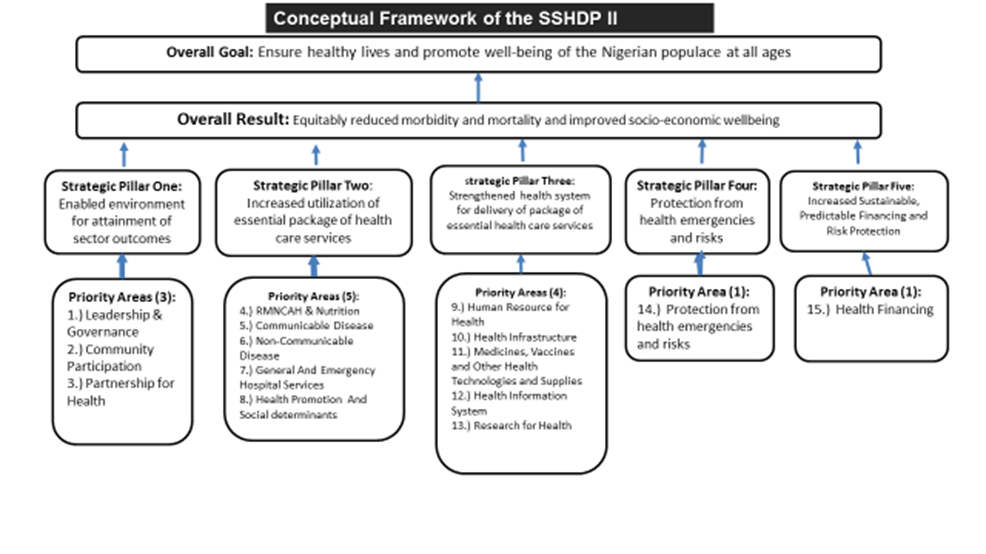
The Lagos State Strategic Health Development Plan (SSHDP) is a Strategic document developed to lay out the priorities of the state’s health sector in assuring qualitative healthcare for residents and improved health indicators. The first Lagos State Strategic Health Development Plan (SSHDP I) was developed in 2010 in which the State adopted the eight strategic domains of the National Strategic Health Development plan (NSHDP).
The current plan – Lagos SSHDP (2018-2022) was developed with 15 priority areas intended to facilitate the translation of the State Health Policy into practical objectives, strategies and form the basis for resource allocation to be deployed by the Ministry of Health in their implementation. Emphasis is on ensuring that the articulated activities form the basis of operational plan for the next 5 years (2018-2022) and the futuristic State’s policy thrusts and strategic directions are adequately captured taking into consideration current budgetary allocations as well as the generated cost assumptions.
The directorate celebrates the Data Privacy Day (DPD) yearly on the 28th of January in recognition of the impact of data in increasing access to quality health services and improving overall health outcomes. DPD creates awareness on importance of safe guarding Health data of Lagosians as well as the promotion of privacy practices and principles.
Lagos State Ministry of Health HREC” has been duly registered with the National Health Research Ethics, Nigeria. The Committee has been registered as a Category C Committee: it is authorised to review phases III and IV clinical trials, social and behavioural research, alternative and complementary medicines, epidemiological studies and trials in vulnerable populations.
Ministry of Health essentially aims to improve healthcare services delivery to the yearning and teeming populace of the State citizenry with the provision of state-of-the-art facilities. This is made possible with the construction of new health facilities, continuous rehabilitation / upgrading of existing health facilities and the efficient monitoring of the on-going renovations.

